
 Michael Atkinson
You just have to shoot respect rainbows over to Joanna Arnow, whose first feature, The Feeling That the Time for Doing Something Has Passed, is as unglamourously, un-narcissistically naked as a 21st-century indie might ever get. You could even call it masochistic, particularly as Arnow wrote, directed, and edited the thing, in addition to starring, half the time in the nude. She puts herself right out there, and it’s difficult to escape the sense, right under the thin veneer of cruel, deadpan comedy, that she’s paying a penance, or flogging herself for some old sin.
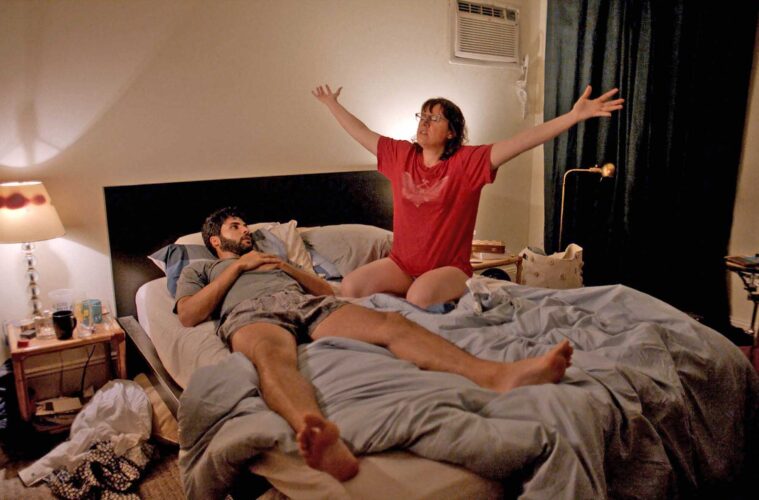
The film itself, which actually only plays as a comedy if you, the viewer, are some kind of sadist, wraps itself around the wilting tail end of a long-term BDSM relationship. Arnow’s Ann is a drab, downtrodden, 30ish Brooklynite who is the submissive to Allen (Scott Cohen), an older, divorced dom who barely seems interested in their limp, nine-years-running interplay of humiliation and role-playing. Commands to spread butt cheeks on Zoom and to jump out of bed and stand against the wall are as intense as it gets. It’s clear that this is Ann’s idea of a fun Saturday night, though — when she starts app-dating other, younger men, the play quickly turns toward the mortifying, the nadir of which involves a pig-snout get-up and “Fuck Pig” scrawled across her belly in Magic Marker.
Not funny, you’d think, and it’s not — Arnow tries to resurrect zombie chuckles out of the pathetic, and as I say, where you find your humor is your business. Arnow is die-hard not just about her own constant nudity — it’s one of the unsexiest movies about sex ever — but also her tonal approach. Assembled out of disconnected vignettes, the film occupies the emotionally benumbed territory of an entire school of ’80s–’90s indie, in which mild absurdities are met with frozen nonreactions, in the borrowed manner (but not the rigor) of Jim Jarmusch and Aki Kaurismäki. (Little in the film is quite as witty as Arnow’s seductively mouthy title.) Here, Ann suffers stilted crap from her turgid office job, and her parents (Arnow’s actual mom and dad) and her dates are flat caricatures. We get to see her squeeze prepackaged dal into a bowl in lengthy close-up, twice.
There are a few unexpected swells in the film’s fairly brutal flat-line affect — a propos of nothing, her dad (David Arnow, a teacher at Brooklyn College) gets to strum and sing out an old union anthem, and Ann’s late-coming bond with Chris (Babak Tafti), a sweet un-sadist who’s entranced by Ann’s Les Miz obsession, temporarily warms up the film; he even tries to make Ann cum. (She’s not thrilled.) But take Arnow’s title seriously — the film’s thrust is decidedly post-hope, post-pleasure, and post-happiness. The fictionalization of Arnow’s travails is, however, a relief compared to her even more masochistic navel-plunge featurette-doc I hate myself:), from 2013, a film that inherently and purposefully makes you question how much of anyone’s misery and willing subjugation should be put on film for the world to enjoy.
You may wonder what’s wrong with Ann, but Arnow does not entertain the question. Maybe it seems obvious to her. All the same, long before the end of the film, you’ll be wanting Ann to put her clothes back on and tell her various abusers to go tell it on the mountain. At least, you will wish she’d show some of the chutzpah Arnow did in making the film at all.
Advertising disclosure: We may receive compensation for some of the links in our stories. Thank you for supporting LA Weekly and our advertisers.